Automating cart recovery on WhatsApp
Timing, copy, and the offer ladder that turns an abandoned cart into a completed order — without giving away margin you did not need to.
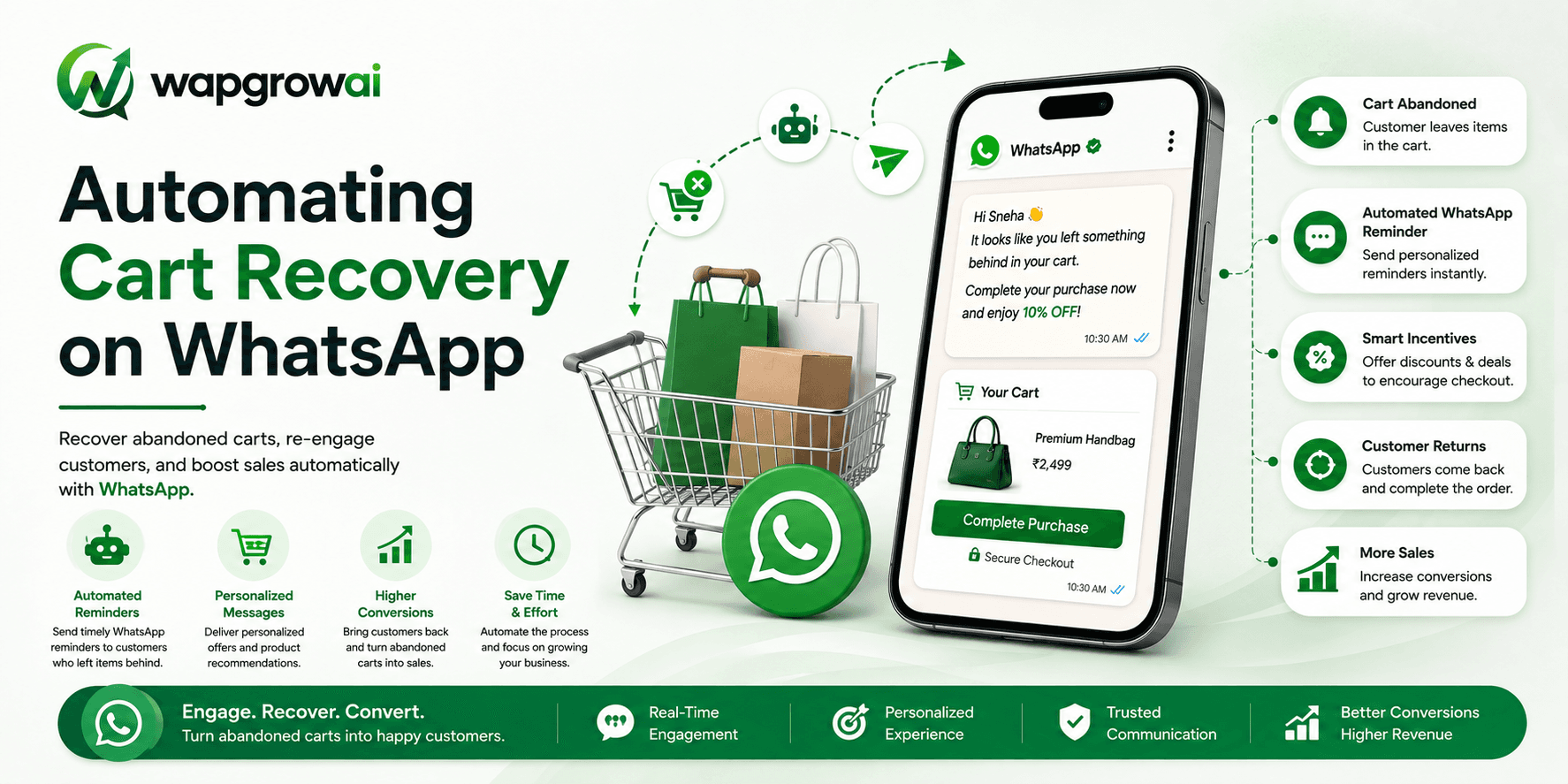
Somewhere between seven and eight of every ten carts on a typical store are abandoned. Every recovery channel you have ever used is a response to that number: the email sequence, the retargeting pixel, the exit-intent pop-up. WhatsApp is simply the first one where the message reliably gets read within minutes rather than eventually.
That changes the design of the whole flow. On email, you write for someone who will see the message hours later, in a different frame of mind, alongside forty other messages. On WhatsApp, you are writing to someone who probably still has your product page open in another tab.
Why carts actually get abandoned
Before touching the copy, it is worth being precise about the problem, because most recovery flows are built on a false assumption: that abandonment is a price objection. Usually it is not.
- Interruption. The customer was doing something else and never came back. This is the largest group by a wide margin.
- Friction. The checkout asked for something they did not have to hand — a card, an address, an account.
- Uncertainty. Delivery time was unclear, the returns policy was hard to find, the size chart was ambiguous.
- Comparison. They went to check a competitor's price and did not return.
- Price. Genuine sticker shock. Real, but far smaller than most teams assume.
Only the last group needs a discount. Every other group needs a reminder, a removed obstacle, or an answered question — all of which are free. If your recovery flow opens with an offer, you are paying to solve a problem most of your abandoners do not have.
The three-message ladder
The structure that consistently performs across categories is a ladder: each message escalates only if the previous one failed, and the incentive appears last rather than first.
Message one — the reminder, within the hour
Sent sixty to ninety minutes after abandonment. No offer, no urgency, no marketing language. Name the product, show the price, and give a single tap back to the cart.
This message does the majority of the work in most stores, and it costs you nothing in margin. Its only job is to solve the interruption problem — and the interruption problem is the biggest one you have.
Message two — the objection, at twenty-four hours
If the first message did not convert, the second addresses the most common reason people in your category hesitate. Not a generic reassurance — the specific one.
- Apparel: sizing and free returns.
- Electronics: warranty and delivery date.
- Furniture: delivery window and assembly.
- Consumables: subscription flexibility and the ability to cancel.
You can discover this without guessing. Ask. A one-question broadcast to a sample of abandoners — 'what stopped you?' with three buttons — will tell you more in an afternoon than a quarter of A/B testing.
Message three — the incentive, at seventy-two hours
Only now does an offer make sense, and only to the people who have ignored two messages that gave them every reason to buy at full price. This is also where the free service window matters: if the customer replied to either earlier message, this one costs you nothing to send.
Getting the timing right
Timing is the single biggest lever in the entire flow, and it is the one most stores get wrong by copying their email cadence.
An email sent an hour after abandonment is early. A WhatsApp message sent an hour after abandonment is late.
The intent curve on WhatsApp is steep. The value of a reminder decays quickly, because the customer's context — the tab, the decision, the mood — decays quickly. Sending inside the first hour materially outperforms sending at the four-hour mark in every test we have seen.
Two constraints sit on top of that. Respect quiet hours in the customer's timezone; a recovery message at two in the morning converts nobody and earns you a block. And do not stack the flow on top of a broadcast the same person received that day — the combined volume, not the individual message, is what drives opt-outs.
Writing messages that do not read like automation
The tell of an automated cart message is that it talks about the cart. Customers do not think in carts. They think about the thing they nearly bought.
- Name the product, not the basket. 'The Ethiopian blend is still available' beats 'You left items in your cart'.
- Show the price. Hiding it forces a click to answer a question the customer already has.
- Use one link. Two competing calls to action reliably halve the click rate.
- Write the way your support agents write. If the recovery message and the human reply sound like different companies, the illusion collapses on the first response.
That last point deserves emphasis. On WhatsApp, an automated message can be replied to. When someone answers your cart reminder with a question, they are now in a conversation with your business — and if a human picks it up quickly, the recovery rate on that thread is dramatically higher than on any automated path.
Wiring it up
Mechanically, the flow needs four things, and none of them require a developer if your store platform is connected.
- An abandonment event from your store — Shopify, WooCommerce, or a webhook from a custom platform.
- An opted-in WhatsApp contact, matched to that cart by phone number.
- A Meta-approved template for each message in the ladder, because the first contact falls outside the free window.
- An exit condition: the moment the order completes, the remaining messages must stop.
What to measure
Four numbers, and one of them is a trap.
- Recovery rate per message, so you can see which rung of the ladder is doing the work.
- Recovered revenue net of discount — not gross. A flow that recovers more revenue at a lower margin can easily be worse.
- Reply rate, because replies open the free window and dramatically improve the economics of everything downstream.
- Full-price recovery share. If this is falling, your discount is arriving too early.
The trap is gross recovered revenue. It always goes up when you discount harder and send more often, right up until the moment your list stops responding at all.
The version that works
A good cart recovery flow on WhatsApp is short, fast, and stingy with incentives. It reminds people quickly, answers the question that stopped them, and only pays for the sale when it has run out of cheaper ways to earn it.
Do that, and recovery becomes a durable line of revenue rather than a discount habit you cannot get out of. Most stores can build the whole thing in an afternoon, and the first message alone will usually justify the effort.
Opt-in: the constraint that shapes everything
None of the above is legal, or even technically possible, without an opted-in contact. You cannot message somebody on WhatsApp because they typed their number into your checkout. They have to have agreed to hear from you.
This is the real bottleneck in cart recovery, and it is why so many stores have a beautiful flow that reaches almost nobody. Fixing the opt-in is worth more than any amount of copy tuning.
- Put the opt-in at checkout, as a checkbox with a plain-language promise: order updates on WhatsApp. Most people say yes, because they want the updates.
- Offer it again on the order confirmation page, framed as tracking rather than marketing.
- Use a click-to-WhatsApp entry point on the product page — 'ask us about this' — which opts them in by virtue of them messaging first.
- Never buy a list. It will destroy your quality rating within a week and the account may not come back.
The other flows worth building once this one works
Cart recovery is the first automation because it pays for itself fastest. It is not the only one, and the same ladder logic applies to each.
Browse abandonment
The customer viewed a product several times and never added it. Weaker intent than an abandoned cart, so the message must be softer — a question rather than a nudge. 'Still deciding on the Ethiopian? Happy to answer anything.' It converts less often, but it costs almost nothing and it opens conversations.
Back in stock
The highest-converting message in retail, because the customer explicitly asked. Send it to the people who asked and nobody else, and send it the hour the stock lands, not in the next scheduled batch.
Replenishment
For consumables, the reorder prompt timed to when the product actually runs out. A coffee bag lasts a fortnight; a razor cartridge lasts a month. Getting this interval right turns a one-off buyer into a subscription without anybody having to sign up for one.
Post-delivery check-in
Two days after delivery, one question: did it arrive as expected? It catches problems before they become reviews, it opens the messaging window, and a meaningful share of the replies turn into a second sale.
A note on discount discipline
Every recovery flow eventually faces the same internal pressure: the numbers would look better if the discount came earlier. They would. For a quarter.
Teach customers that abandoning a cart produces a discount, and you have not built a recovery flow. You have built a coupon dispenser with an extra step, and your best customers will learn to use it.
Watch full-price recovery share as a hard guardrail. If the proportion of carts recovered without any incentive is falling month over month, your discount is arriving too early and your customers have noticed. Pull it back a rung and accept the short-term dip; the margin comes back within a cycle or two.
What to expect, honestly
Recovery rates vary enormously by category, price point, and how well the opt-in is doing. Anyone quoting you a single number is selling something. What is consistent is the shape: the first reminder does most of the work, the objection-handling message adds a solid increment, and the discount recovers the stubborn remainder at a cost you should be watching closely.
Build the ladder, protect the opt-in, and keep the incentive on the bottom rung. That is the whole method, and it will outperform a cleverer flow that skips straight to the coupon every time.
The mistakes we see most often
Having reviewed a great many of these flows, the failures cluster. Almost all of them are one of five things.
Sending too late
The flow fires at the four-hour mark because that was the email cadence and nobody revisited it. Four hours on WhatsApp is a different world from four hours in an inbox; the customer has finished their commute, cooked dinner, and forgotten your existence.
Leading with the discount
Covered above, but worth repeating because it is the most expensive mistake on the list. It converts well immediately and it corrodes your margin permanently.
Not stopping on purchase
The customer buys, and the sequence sends the discount message anyway the following morning. This is not a small error. It is a discount handed to somebody who paid full price, and they will remember it next time.
Ignoring the reply
Somebody answers the cart reminder with a question, and the automation carries on regardless, sending message two on schedule while the customer waits for an answer to something they actually asked. Every recovery flow must pause the instant a human replies, and hand the thread to a person.
Running the same flow for every product
A twelve-pound consumable and a nine-hundred-pound sofa do not warrant the same three messages on the same schedule. High-value carts deserve a human, and they will repay one.
None of these are exotic failures. They are what happens when a flow is switched on in an afternoon and never looked at again. Put a monthly review in the calendar, read ten real recovery conversations end to end, and you will catch every one of them before they cost you a quarter.
Three more,
worth your time
Ready togrow on WhatsApp?
Join 10,000+ businesses turning conversations into revenue.
Start free trialBook a demo