
7 WhatsApp broadcast templates that convert
The exact templates behind our highest-performing campaigns — and why each one earns the open rather than borrowing it.
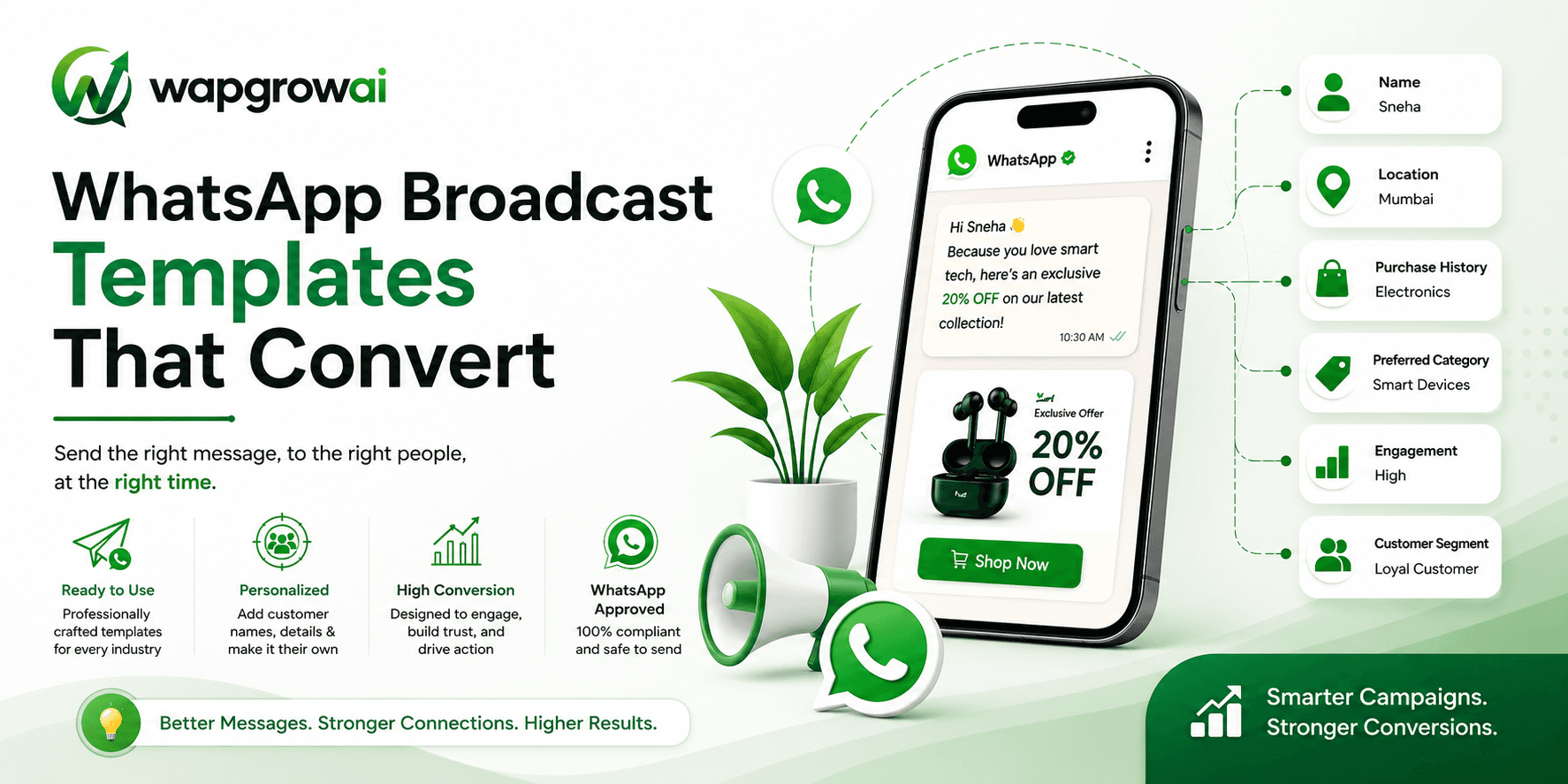
A WhatsApp broadcast is not an email with a smaller word count. Email is a channel people check; WhatsApp is a channel people live in. The message you send lands between a note from a customer's sister and a photo from their group chat, which means it is read within minutes — and judged just as fast. That proximity is the whole opportunity, and it is also the whole risk.
We have sent tens of millions of broadcasts on behalf of businesses on WAPGROWAI, and the pattern is consistent: the campaigns that work are not the ones with the cleverest copy. They are the ones where the message had an obvious reason to exist. Below are seven templates that keep earning their place, with the reasoning behind each and the mistakes we see most often.
Why open rate is the wrong thing to optimise
Almost every WhatsApp case study leads with an open rate somewhere north of 90%. It is a true number and a useless one. On a channel where the message appears as a notification on a lock screen, opening it is close to involuntary. Optimising for opens is optimising for something you already have.
The metrics that separate a good campaign from an expensive one are further down the funnel: reply rate, click-through, conversion, and — the one nobody likes to publish — block and report rate. A broadcast that gets a 96% open rate and a 3% block rate has not succeeded. It has borrowed attention it will not be given again.
Treat every broadcast as a withdrawal from an account you cannot easily top up. The question is not whether people will read it. It is whether they will be glad they did.
With that framing, the templates stop being copy formulas and start being reasons. Each of the seven below exists because it gives the recipient something: information they need, money they save, a decision made easier, or a problem solved before they noticed it.
Template 1 — The status update they were already waiting for
The single highest-performing broadcast type is the one nobody thinks of as marketing. An order confirmation, a dispatch notice, a delivery window, an appointment reminder. These messages are welcome because the recipient was already wondering about them, and every one of them creates an opening for a second sentence that is commercial.
The structure is simple: confirm the thing, then give one useful next action. Not three. One.
- Open with the fact, not the greeting: 'Your order #4021 is out for delivery.'
- Give the detail that removes uncertainty: a time window, a tracking link, a courier name.
- Offer exactly one next step: track it, reschedule it, or ask a question.
- Keep the commercial line to a single sentence, and make it relevant to the order at hand.
The mistake we see: businesses treat the transactional message as sacred and refuse to put anything commercial in it at all, or they treat it as a billboard and staple three promotions to the bottom. Neither is right. One relevant line, related to what the customer just bought, converts better than an entire promotional broadcast sent two days later.
Template 2 — The abandoned cart, sent like a person
Cart recovery is the most reliable revenue you will find on WhatsApp, and the copy matters less than the timing. The first message should go out within an hour, before the intent has cooled and while the decision is still live in the customer's head.
Resist the temptation to lead with a discount. The majority of abandoned carts are not price objections — they are interruptions. The customer got distracted, the payment page asked for something they did not have to hand, the delivery estimate was unclear. A message that simply removes the friction recovers a surprising share of them at full margin.
- Hour one: a plain reminder with the item, the price, and a one-tap link back to the cart. No offer.
- Day one: address the most common objection directly — delivery time, returns policy, or sizing.
- Day three: only now, if it still has not converted, introduce an incentive.
Sequencing this way protects your margin. If you open with 10% off, you have just given a discount to every customer who was going to complete the purchase anyway, and you have taught the rest of them to abandon their cart on purpose next time.
Template 3 — The restock, sent only to people who care
A back-in-stock alert is the closest thing to a guaranteed conversion in retail, because the audience has already self-selected. Somebody asked to be told. The only way to ruin it is to broadcast it to your whole list.
The discipline here is segmentation, not copy. If a hundred people asked about a product, send it to those hundred people. The temptation to reach ten thousand with the same message is exactly how a valuable list stops being valuable.
Template 4 — The launch, framed as an invitation
Launch broadcasts fail when they read as an announcement. Nobody wakes up hoping for news about your product. They do, however, respond to being given something early.
Frame the launch as access rather than information. Early access, a window before the public sale, a limited allocation for existing customers. The content of the message is nearly identical; the position of the recipient in it is completely different. One says 'here is a thing we made.' The other says 'here is a thing you can have before everyone else.'
The structure that works
- Line one: what it is, in plain words, with no adjectives.
- Line two: why this person is hearing about it now.
- Line three: the window — when it opens, when it closes.
- One button. 'See it first' beats 'Learn more' every time.
Template 5 — The win-back that admits the gap
The lapsed-customer broadcast is where most brands sound the most like brands. 'We miss you!' is a sentence no human has ever said to another human about a shampoo subscription.
What works instead is acknowledging the gap plainly and giving a reason to reconsider that is about the product, not the relationship. Something changed. A new size, a fixed problem, a better delivery window, a range they asked about that now exists. If nothing has changed, a win-back message is just a discount with a story attached, and customers can tell.
The best win-back message is one where the reason for sending it would still be interesting to a brand-new customer.
Template 6 — The single-question survey
WhatsApp is the only channel where asking a question is a reasonable thing to do at scale, because replying costs the customer almost nothing. A single tappable question — one question, three buttons — routinely gets response rates that would be impossible on email.
Use it to make a decision you are actually going to act on. Which of two products to stock. Whether the delivery window was acceptable. Why they did not complete the purchase. The reply is data, but it is also a conversation opener: the customer has now messaged you, which means the messaging window is open and your next reply costs nothing.
That last point is the one most teams miss. A survey broadcast is not just research. It is a way to convert a broadcast list into an active thread, and an active thread is worth considerably more than a passive contact.
Template 7 — The seasonal offer, made specific
There is nothing wrong with a sale broadcast. There is a great deal wrong with a sale broadcast that could have been sent by any business in your category.
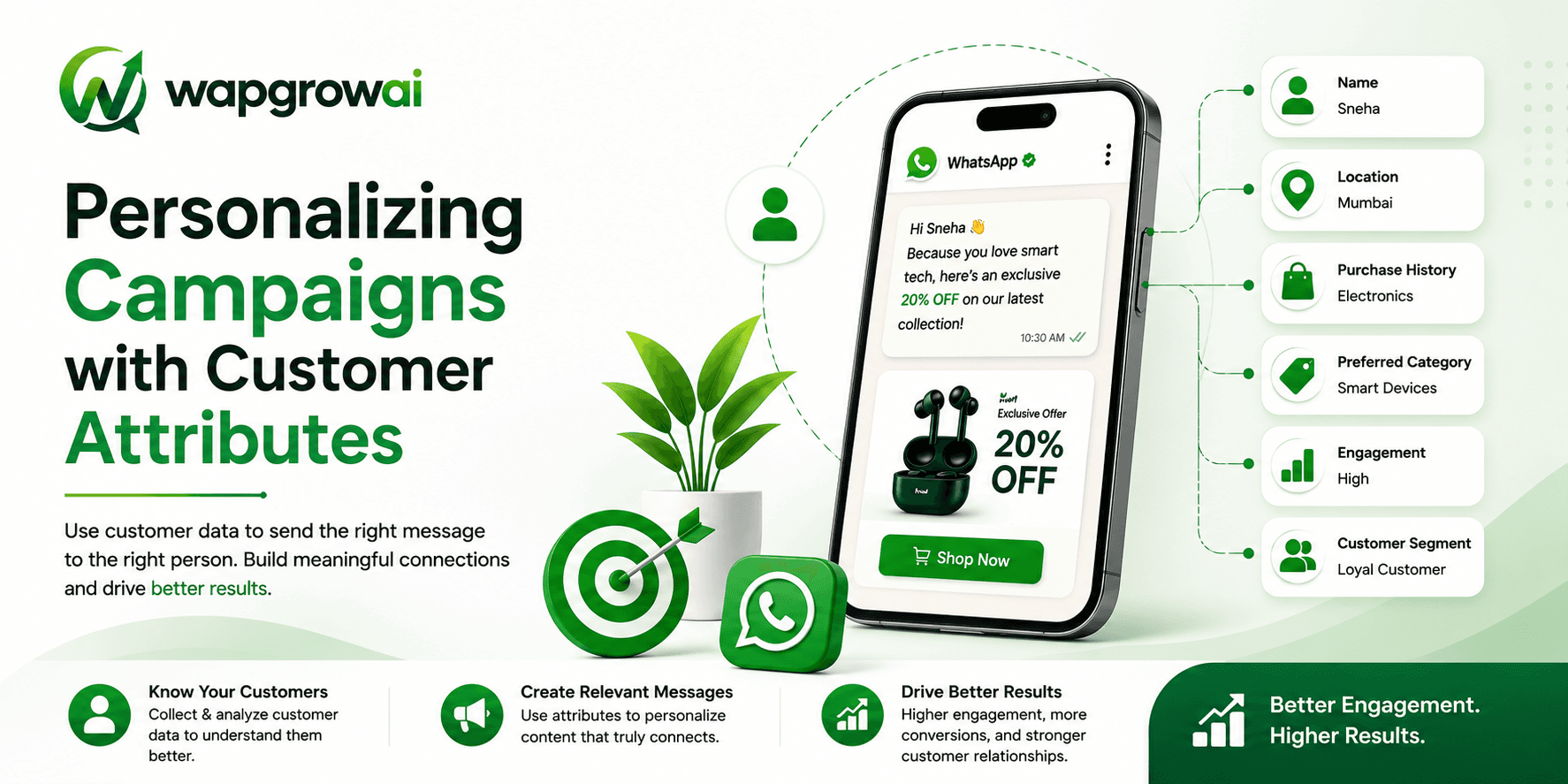
The fix is specificity. Not '30% off everything' but '30% off the blend you bought in March.' Not 'our biggest sale' but 'the two items still in your cart are in it.' Personalisation on WhatsApp is not about inserting a first name. It is about the message only making sense if it was sent to that person.
What to measure once they are live
For every broadcast, track four numbers and ignore the rest until those four are healthy.
- Reply rate. On WhatsApp, a reply is engagement in a way a click never is — and it opens the free service window.
- Click-through to the action you actually wanted, not to any link in the message.
- Conversion within seventy-two hours, so the free window is doing the work rather than another paid template.
- Block and report rate. Watch this one weekly. It is the only metric that can quietly end the channel for you.
A campaign that converts at a lower rate but keeps your block rate near zero is worth more over a year than one that spikes and burns the list. WhatsApp punishes extraction and rewards restraint, which is unusual among marketing channels and takes some getting used to.
The rule underneath all seven
Every template here is a variation on the same idea: send the message the customer would have wanted even if you had nothing to sell. The order update they were waiting for. The restock they asked about. The question you actually needed answered. The commercial value comes second, and it comes reliably, precisely because it comes second.
Businesses that internalise that end up sending fewer broadcasts and earning more from them. Businesses that do not end up with a large list, an impressive open rate, and a slowly rising block rate that nobody looks at until the quality rating drops. Pick the first one.
A worked example: one month, four sends
Abstract advice is easy to nod along to and hard to act on, so here is what a disciplined month actually looks like for a mid-sized retailer with a list of forty thousand opted-in contacts. Four sends. Not twelve.
Week one: the utility send that nobody counts as marketing
Order and dispatch notifications go out continuously, to whoever ordered. Nobody plans them, nobody reports on them, and they quietly account for the largest share of clicks the business gets all month. Each one carries a single relevant line — a related product, a reorder prompt, a reminder that returns are free for thirty days. Nobody experiences it as a campaign, because it is not one.
Week two: the restock, to four hundred people
A popular line comes back into stock. The message goes to the four hundred people who asked to be told, and to nobody else. The conversion rate is extraordinary, the absolute revenue is modest, and the temptation to send it to all forty thousand is enormous. Resisting that temptation is the entire discipline of this channel.
Week three: the single question
A one-question survey goes to a segment of five thousand lapsing customers: why did you stop buying? Three buttons — price, range, service. The replies are useful in themselves, and they open the messaging window on several hundred conversations, which the team then works manually. That week's revenue comes almost entirely from the follow-up conversations, not from the survey.
Week four: the seasonal offer, narrowly aimed
The only conventionally promotional send of the month, and it goes to perhaps eight thousand people rather than the whole list — those who have bought in the category before, or browsed it, or asked about it. The copy names the product they engaged with. It converts at several times the rate the full-list version would have, and the block rate barely moves.
Total marketing sends: two. Total revenue: higher than the month before, when the same team sent nine broadcasts to everybody and watched their quality rating slide from green to yellow.
The objections you will hear internally
Every recommendation above will meet resistance, usually from someone whose targets are measured in sends. The objections are predictable, and they are worth having good answers to.
'We have forty thousand contacts, why would we message eight thousand?'
Because the other thirty-two thousand were not going to buy this product, and now they have received a message that was irrelevant to them. They will not complain. They will simply become slightly less likely to read the next one, and a fraction of them will block you. Reach is not free on this channel; it is paid for in future attention.
'Our open rate is 94%, the campaign clearly worked'
The open rate was 94% before you wrote anything. It will be 94% for a badly written message and 94% for a brilliant one. It is a property of the channel, not a verdict on your work. Look at the reply rate and the block rate instead — those are the two numbers that actually respond to what you did.
'Email lets us send weekly, why is WhatsApp different?'
Because an unwanted email is ignored and an unwanted WhatsApp message is an interruption. The customer has to actively dismiss it, on the same screen where their family messages them. The cost of being unwanted is an order of magnitude higher, and so is the reward for being wanted.
How to know it is going wrong before the data does
Block rate and quality rating are lagging indicators. By the time they move, the damage is a few weeks old. There are earlier signals, and they are all qualitative.
- Reply rate falling while click rate holds steady. People are still tapping, but they have stopped talking to you — the relationship is becoming transactional.
- Replies getting shorter and more terse. Read ten of them a week; you will feel this long before a chart shows it.
- The team starting to phrase campaigns defensively — 'sorry for the message, but…'. If the sender feels like an intrusion, they are one.
- Segments being widened to hit a revenue number. This is always the first step of the death spiral, and it always feels reasonable at the time.
The businesses that keep WhatsApp working for years are not the ones with the best copywriters. They are the ones with somebody senior enough to say no to a send — and the discipline to keep saying it in a quarter where the numbers are behind.
Three more,
worth your time
Ready togrow on WhatsApp?
Join 10,000+ businesses turning conversations into revenue.
Start free trialBook a demo