
Personalizing campaigns with customer attributes
Segments, variables, and lifecycle stages — personalization that survives contact with scale, rather than merging a first name.
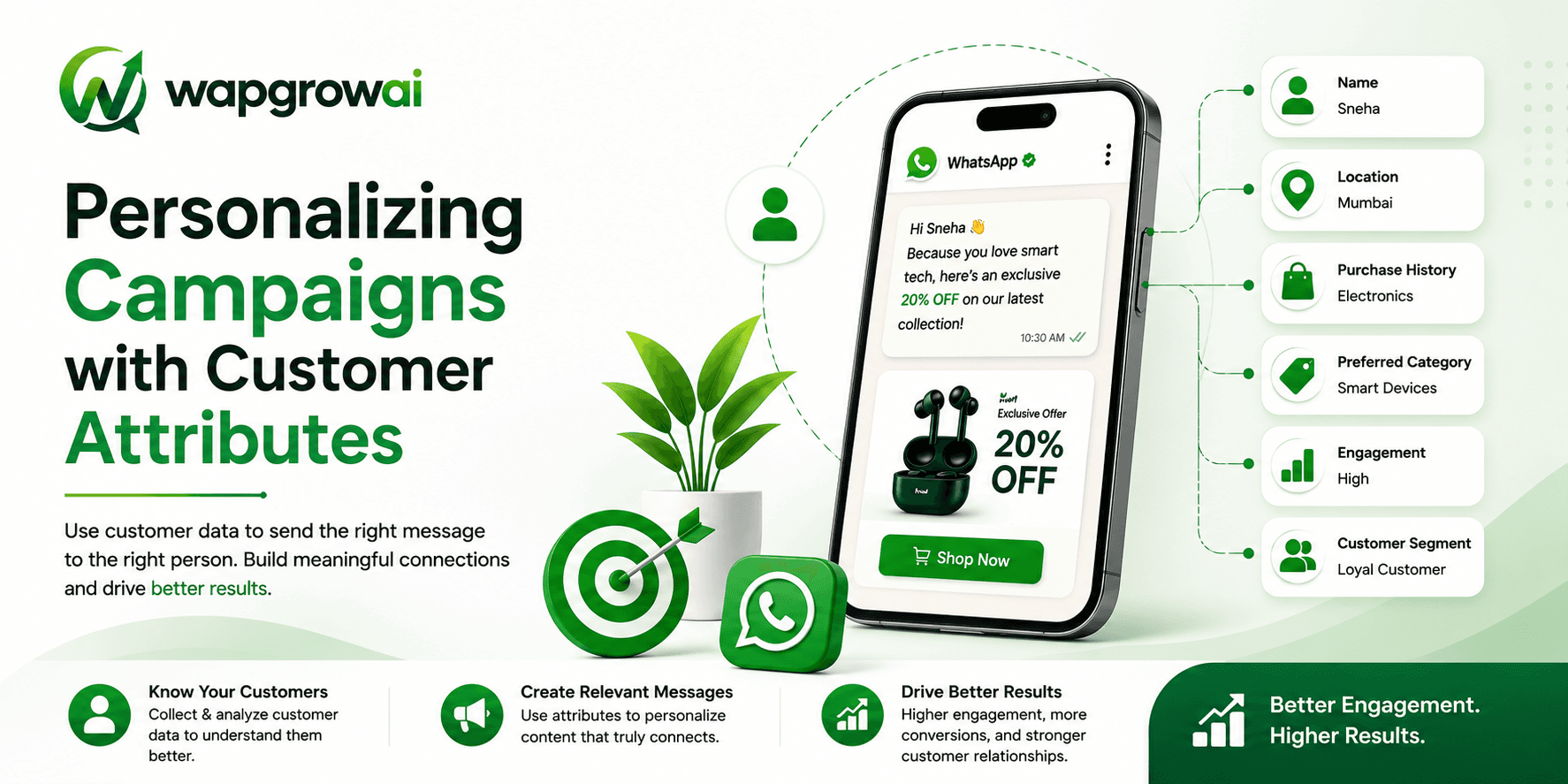
Most WhatsApp personalisation is a first name in a greeting, which fools nobody. The customer knows you have their name. Using it proves only that you have a database, and a message that would read identically if you swapped the name in is not personalised — it is merged.
Real personalisation passes a simple test: strip out every variable and the message stops making sense, because it was written for a situation rather than for a person's spelling.
The three layers, in order of value
There are three kinds of attribute you can personalise on, and they are not equally useful.
Identity: who they are
Name, city, language, account tier. The easiest to collect and the least valuable on its own. Language is the exception — sending in the customer's own language is not a nicety, it is a conversion lever, and it is the one identity attribute that changes behaviour.
Behaviour: what they have done
Purchases, browsing, replies, clicks, abandoned carts, support history. This is where personalisation stops being decorative. A message that references what somebody actually did is a message they cannot ignore, because it is evidently about them.
Lifecycle: where they are in the relationship
New, active, lapsing, lapsed, loyal. The most valuable layer of all, because it determines what you should be trying to achieve rather than merely what you can mention.
Identity tells you how to address someone. Behaviour tells you what to say. Lifecycle tells you why you are messaging at all — and if you cannot answer that, do not send.
Segments that earn their existence
Every marketing team eventually builds forty segments and uses four. The other thirty-six are a taxonomy nobody maintains and everybody is slightly afraid of.
A segment is only worth creating if you would send it a different message. That is the entire test. If two segments would receive the same broadcast, they are one segment with extra steps.
- Recent purchasers, who should not be receiving acquisition offers.
- Cart abandoners, who need a reminder rather than a campaign.
- Lapsing customers, who need a reason to reconsider rather than a discount.
- High-value regulars, who should hear about things first and be asked for their opinion.
- Never-engaged contacts, who should be sent less, not more.
That last group is the one that gets abused. When a campaign underperforms, the instinct is to widen the audience. The correct response is usually to narrow it — the non-responders are not an untapped market, they are a quality rating problem accumulating quietly.
Dynamic segments, not static lists
A static list is out of date the moment you export it. Somebody on your cart-abandoner list bought the thing an hour ago, and now you are about to offer them a discount on a product they already own at full price.
Segments should be rules, evaluated at send time. 'Bought in the last thirty days.' 'Has an open cart older than an hour.' 'Has not replied to the last three broadcasts.' The membership changes by itself, which means the campaign is correct on the day it goes out rather than on the day somebody built the list.
Variables that are worth the setup
Template variables are limited by Meta's approval rules, so spend them where they earn the most.
- The product they actually interacted with. Not 'our range' — the item.
- The number that matters to them: their order total, their points balance, their delivery date.
- The date or window that makes the message urgent for them specifically.
- The name, last. It is fine to use, it is just doing far less work than people believe.
Language, properly
If you operate across languages, this is the highest-leverage attribute you have, and it is routinely handled badly — usually by sending everybody English and hoping.
Store the language preference explicitly rather than inferring it from a country code. Approve templates in each language. And make sure the reply path speaks it too: there is nothing worse than a personalised message in Portuguese that, when replied to, produces an agent who cannot read it.
Testing without deceiving yourself
A/B testing on WhatsApp is easy to run and easy to misread, because the volumes are large enough to produce impressive-looking differences that mean nothing.
- Test one variable at a time. Copy or timing or segment — not all three.
- Test on the metric you care about, which is conversion, not open rate. Open rate barely moves on this channel.
- Hold the test long enough to see the block rate, which lags the click rate by days.
- Keep a holdout group. Without it, you cannot tell whether personalisation is working or whether the segment was simply going to buy anyway.
The holdout is the discipline that most teams skip and most regret skipping. Personalised campaigns aimed at high-intent segments always look brilliant, because high-intent segments always convert. The holdout is the only thing that tells you whether your message did any work.
The standard to hold yourself to
Before any broadcast, read it as if you were the recipient and ask one question: could this have been sent to anybody? If the answer is yes, it is not personalised, and the open rate it earns will be borrowed rather than deserved.
Get that right and personalisation stops being a feature you switched on and becomes the reason people keep reading your messages — which, on a channel this intimate, is the only long-term strategy there is.
Where the attributes actually come from
All of this depends on knowing things about people, and most businesses know far less than they think. The data exists — it is simply scattered across systems that do not talk to each other, which is a solvable problem and rarely a glamorous one.
- The store. Purchases, order values, categories, frequency. This is the richest source you have and it is usually the one least connected to your messaging.
- The conversation itself. What people asked about, what they complained about, which flow they went down. Astonishingly underused.
- Explicit preference. You are allowed to simply ask — a one-question survey collects a preference more accurately than any inference model.
- Behavioural signals from your site, if you can match them to a phone number.
The second one deserves particular attention. Every support conversation is a personalisation opportunity nobody harvests. A customer who asked twice about delivery to a rural address has told you something useful about what to say in the next message. Most businesses let that fall on the floor the moment the ticket closes.
Privacy, consent, and not being creepy
There is a line, and personalisation crosses it more easily on WhatsApp than anywhere else, because the channel is personal to begin with.
The rule that keeps you the right side of it: reference things the customer knows you know. They know you know what they bought — they bought it from you. They know you know their cart contents. They do not necessarily expect you to know that they looked at a product three times last Tuesday, and being told so is unsettling rather than helpful, even when it is technically accurate.
- Use behavioural data to decide what to send. Do not always announce that you used it.
- 'The Ethiopian is back in stock' is helpful. 'We noticed you've viewed the Ethiopian four times' is surveillance.
- Honour deletion and opt-out requests properly and quickly. On a channel this close, a customer who wants out and cannot get out will not merely block you — they will report you.
- Keep consent auditable. When somebody asks why they are receiving messages, you should be able to say exactly when and where they agreed.
Lifecycle: the layer that decides everything else
If you only implement one thing from this article, make it lifecycle stages — because they answer the question that comes before all the others: should we be messaging this person at all, and what are we trying to achieve?
New
The goal is a second purchase, and the fastest route is usually confidence rather than discount. Show them the thing they bought is well cared for. Make returns feel easy. Do not, whatever the temptation, immediately begin broadcasting your full promotional calendar at somebody who has known you for a week.
Active
They are buying. The goal is not to interrupt that. Utility messages, replenishment prompts, relevant new arrivals. Restraint here is worth more than any campaign.
Lapsing
The most valuable segment and the one everybody neglects, because they are not obviously broken. Something is happening — a competitor, a price change, a bad experience. A single, genuine question outperforms an offer at this stage, and it tells you something you can act on.
Lapsed
Now, and only now, an incentive is honest. But the message must give a reason beyond the discount, or you have simply confirmed that the relationship was transactional all along.
Four stages, four different objectives, four different tones. Get this right and the rest of personalisation is detail. Get it wrong and no amount of variable-merging will save the campaign, because you will be sending the right message to somebody who was never in the market for it.
Starting from nothing
Most teams reading this do not have clean lifecycle stages and a rich attribute store. They have a phone number, a first name, and possibly an order history in a system nobody has connected. That is a perfectly reasonable place to start, and the sequence out of it is short.
- Week one: connect the store. Purchase history alone unlocks lifecycle stages, replenishment timing, and category targeting. It is the single highest-value integration you will do.
- Week two: define four lifecycle stages as rules, not lists. New, active, lapsing, lapsed. Argue about the thresholds for an hour and then commit.
- Week three: split one existing broadcast by stage, and write four versions instead of one. Compare the results against the previous month's blanket send.
- Week four: start tagging conversations for what they reveal. In six months this will be the richest data you own.
That is a month of work and it will outperform a year of copy optimisation, because it changes who receives the message rather than merely what it says.
The failure that looks like success
There is one pattern worth ending on, because it catches out competent teams and it is invisible on the dashboard.
You personalise. Results improve. So you personalise harder — narrower segments, tighter targeting, more precise triggers. Results improve again. Encouraged, you narrow further, and now every message goes to the people most likely to convert.
Eventually you are sending brilliantly personalised messages exclusively to people who were going to buy anyway, and congratulating yourself on a conversion rate that measures nothing except how well you selected the audience.
The holdout group is the only defence. Keep one, permanently, in every meaningful segment. Compare against it. It will occasionally tell you something you do not want to hear — that a beautifully personalised campaign added nothing, because those customers were already on their way to the checkout.
That is not a reason to stop personalising. It is a reason to aim it at the people whose behaviour you can actually change, which is where all the value was hiding in the first place.
Three more,
worth your time
Ready togrow on WhatsApp?
Join 10,000+ businesses turning conversations into revenue.
Start free trialBook a demo