
5 click-to-WhatsApp ad strategies that scale
Creative, routing, and attribution tactics that keep cost per lead falling as spend rises — instead of the other way round.
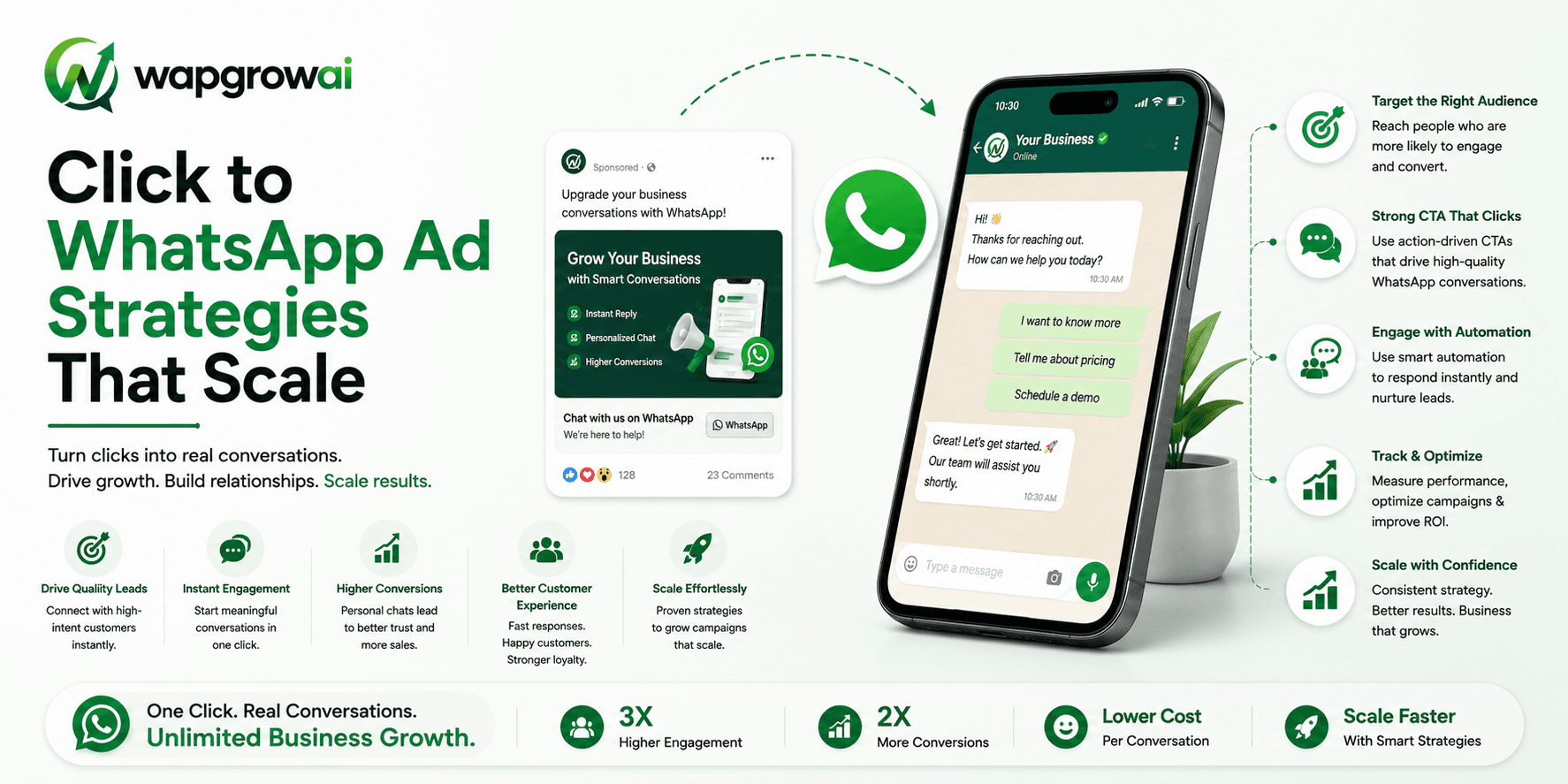
Click-to-WhatsApp ads look like ordinary paid social until you notice what they remove. There is no landing page, no form, no thank-you screen, and no gap between interest and conversation. The customer taps the ad and is instantly in a chat with your business, having said something.
That compression is why CTWA campaigns so often beat their landing-page equivalents on cost per lead. It is also why they fail in a specific and avoidable way: everything downstream of the tap has to be ready, because there is no page to hide behind.
Strategy 1 — Make the ad ask a question
The strongest CTWA creative does not describe the product. It poses the question the customer is already carrying around, and offers to answer it in chat.
The mechanism is simple. A tap on 'Learn more' produces a passive lead. A tap on 'Ask us if it fits your setup' produces someone who arrives in the chat already knowing what they want to say. The first message is the hardest one in any conversation, and good creative writes it for them.
- Frame the CTA as a question the bot or agent can genuinely answer.
- Use the pre-filled message field — it is the most underused setting in the whole ad product.
- Make the pre-filled text sound like the customer, not like you. 'Is this available in my size?' beats 'I would like more information.'
Strategy 2 — Answer in seconds, not minutes
The single largest determinant of CTWA cost per acquisition is not the creative, the audience, or the bid. It is how fast the first reply arrives.
You paid for a moment of intent. If nobody replies for twenty minutes, you have bought a notification and thrown away the intent.
This is where an automated first response earns its keep. Not a full bot conversation — just an immediate, useful acknowledgement that confirms the business is real and present, and ideally asks the one qualifying question that lets you route the lead properly.
The pattern that works: bot replies instantly, qualifies in one or two taps, hands to a human with context attached. The customer experiences continuity; the sales team receives a lead that has already been sorted.
Strategy 3 — Route before you sell
The second most common CTWA failure is a single inbox where enterprise enquiries, price shoppers, and existing customers with a delivery question all land in the same undifferentiated queue.
- Branch on the pre-filled message, which already tells you which campaign they came from.
- Ask one qualifying question — budget, size, category, urgency. One. Not a form.
- Assign to the right team automatically, with the ad name and campaign attached to the thread.
- Give unqualified leads a genuinely useful self-serve answer rather than a queue position.
Routing is what lets CTWA scale. Without it, doubling spend doubles the noise in a single inbox and your response time — the thing that was making the channel work — quietly collapses.
Strategy 4 — Close the attribution loop
The hardest question in CTWA is the most basic one: which ad produced the sale? The click happens on Meta, the conversation happens on WhatsApp, and the purchase often happens somewhere else entirely.
The fix is to carry the campaign identifier through the whole chain and to send the conversion signal back to Meta when the sale lands.
- Capture the referral data that arrives with the first message — it names the ad, the ad set, and the campaign.
- Tag the contact with it, permanently, so it survives into your CRM.
- When the order closes, fire the conversion event back to Meta with that identifier attached.
- Report revenue by campaign, not leads by campaign. Lead volume is the metric that will mislead you fastest here.
Strategy 5 — Use the free window you just paid for
A conversation opened by a click-to-WhatsApp ad comes with a free messaging window. Most advertisers use it for one exchange and then let it expire, which is a little like buying a table at a restaurant and leaving before the starters.
Inside that window, follow-up costs you nothing. The customer who asked about a product and went quiet can be nudged. The one who asked for a price can be sent a comparison. The one who was interested but not ready can be offered a reminder — and all of it is included in the ad click you already bought.
Build the follow-up into the flow deliberately, with a stop condition, and you will find a meaningful share of your CTWA conversions come from the second or third message rather than the first.
What scaling actually breaks
When a CTWA campaign stops working at higher spend, it is almost never the creative. In order of likelihood, it is:
- Response time, which degrades as volume rises and the team falls behind.
- Routing, which was fine at fifty conversations a day and is chaos at five hundred.
- Qualification, which was being done informally by a human who no longer has time to do it.
- Attribution, which was never wired up, so nobody can tell which ad set to cut.
Every one of those is an operations problem wearing a marketing costume. Fix them before you raise the budget, and CTWA scales further than almost any channel you have. Raise the budget first, and you will conclude the channel does not work — when what actually happened is that your inbox stopped answering.
Creative that survives the tap
CTWA creative is judged twice: once in the feed, where it competes for the tap, and once in the chat, where it has to make sense of what just happened. Most advertisers only design for the first.
The failure looks like this. A beautiful ad promises a personalised quote. The customer taps. The chat opens and a bot says 'Hi! Welcome to Acme. How can I help you today?' The promise has evaporated, and the customer is now doing the work of explaining why they are there — which they should never have had to do, because you already knew.
- The first bot message must reference the ad. 'You asked about the Ethiopian blend — let me help with that.'
- Match the tone. A playful ad followed by a corporate greeting reads as a bait and switch.
- Carry the offer through. If the ad said 20% off, the chat must know about the 20%, immediately, without being asked.
- One image, one promise. Ads that make three offers produce conversations where nobody knows which one the customer wanted.
Audience: who CTWA is actually good at reaching
CTWA is not a cheaper version of your existing paid social. It reaches a different person, and the targeting should reflect that.
It performs best with people who have a question — the considering, the comparing, the not-quite-sure. Those people do not fill in forms and they do not read landing pages; they bounce. But they will happily ask a question in a chat, because asking costs them nothing and commits them to nothing.
Which means the audiences worth testing first are the ones your funnel currently loses.
- Site visitors who viewed a product and did not add to cart. They had a question you never answered.
- Cart abandoners who are not on your WhatsApp list — the ad both recovers the cart and opts them in.
- Lookalikes of people who message you, rather than lookalikes of people who buy. Different behaviour, different audience.
- Cold prospecting in categories where the purchase genuinely requires advice. Furniture, insurance, education, anything bespoke.
The economics, laid out
Here is why the arithmetic works, when it works. On a landing-page campaign, you pay for the click, and then you lose the overwhelming majority of those clicks to the form. Your cost per lead is the click price divided by a conversion rate that is usually painfully small.
On CTWA, the tap and the lead are close to the same event. The customer arrives having already sent you a message. There is no form to abandon, because there is no form.
A landing page asks a stranger to fill in a form for a company they have known for four seconds. A chat asks them to send a message — something they do a hundred times a day without thinking.
The catch, and it is a real one: lead quality is lower. It is easier to send a message than to fill in a form, and easy actions attract casual people. This is precisely why qualification and routing matter so much — the channel produces more leads, of which a larger share are unqualified, and the value depends entirely on how quickly you can tell them apart.
A launch plan for the first thirty days
- Week one: two ad sets, one question-led creative each, small budget. Bot replies instantly and asks one qualifying question. Watch response time obsessively.
- Week two: fix whatever week one broke — almost always the handoff or the first bot message. Do not raise the budget yet.
- Week three: wire attribution properly. Capture the referral data, tag the contact, fire conversions back to Meta. Only now is your reporting trustworthy.
- Week four: raise the budget on the ad set with the best cost per qualified lead — not the best cost per lead, which will point you at the wrong one.
The discipline that makes this work is refusing to scale in week one. The channel will look brilliant on day three, because a small volume of conversations is always handled fast. The test is whether it still looks brilliant when there are two hundred of them and everybody is busy.
Reporting CTWA to people who do not use WhatsApp
One organisational problem is worth naming, because it kills more CTWA programmes than any creative failure: the person who owns the ad budget and the person who owns the inbox usually do not report to each other.
Marketing sees cost per lead. Sales or support sees an inbox that keeps filling up. Neither sees the whole chain, and so the arguments are predictable — marketing says the leads are not being worked, operations says the leads are rubbish, and both are partly right.
- Report one number to both teams: cost per qualified conversation. Not leads, not clicks.
- Put response time on the marketing dashboard, where it will be uncomfortable and therefore useful.
- Put ad spend on the operations dashboard, so the queue has a price attached to it.
- Review the two together, weekly, in the same room. The channel is a shared machine and it fails at the seam.
When CTWA is the wrong choice
It is not universally better, and pretending otherwise wastes people's money.
If your product genuinely sells itself from a page — a low-price, well-understood item where the customer has no questions — then sending them into a conversation adds friction rather than removing it. They wanted to buy; you have made them chat.
If you cannot staff replies during the hours your ads run, do not run the ads. A lead that sits unanswered for six hours is worse than no lead, because you paid for it and then confirmed to the customer that you are not there.
And if your team is not prepared to change how it works — if the inbox is going to be checked twice a day between other tasks — the channel will not work, however good the creative is. CTWA does not fail on the ad. It fails, quietly and expensively, on the twenty minutes of silence after the tap.
Three more,
worth your time
Ready togrow on WhatsApp?
Join 10,000+ businesses turning conversations into revenue.
Start free trialBook a demo