
WhatsApp commerce: catalogs and checkout
Selling inside the thread — catalogs, carts, payment links, and the handoffs that quietly kill the conversion.
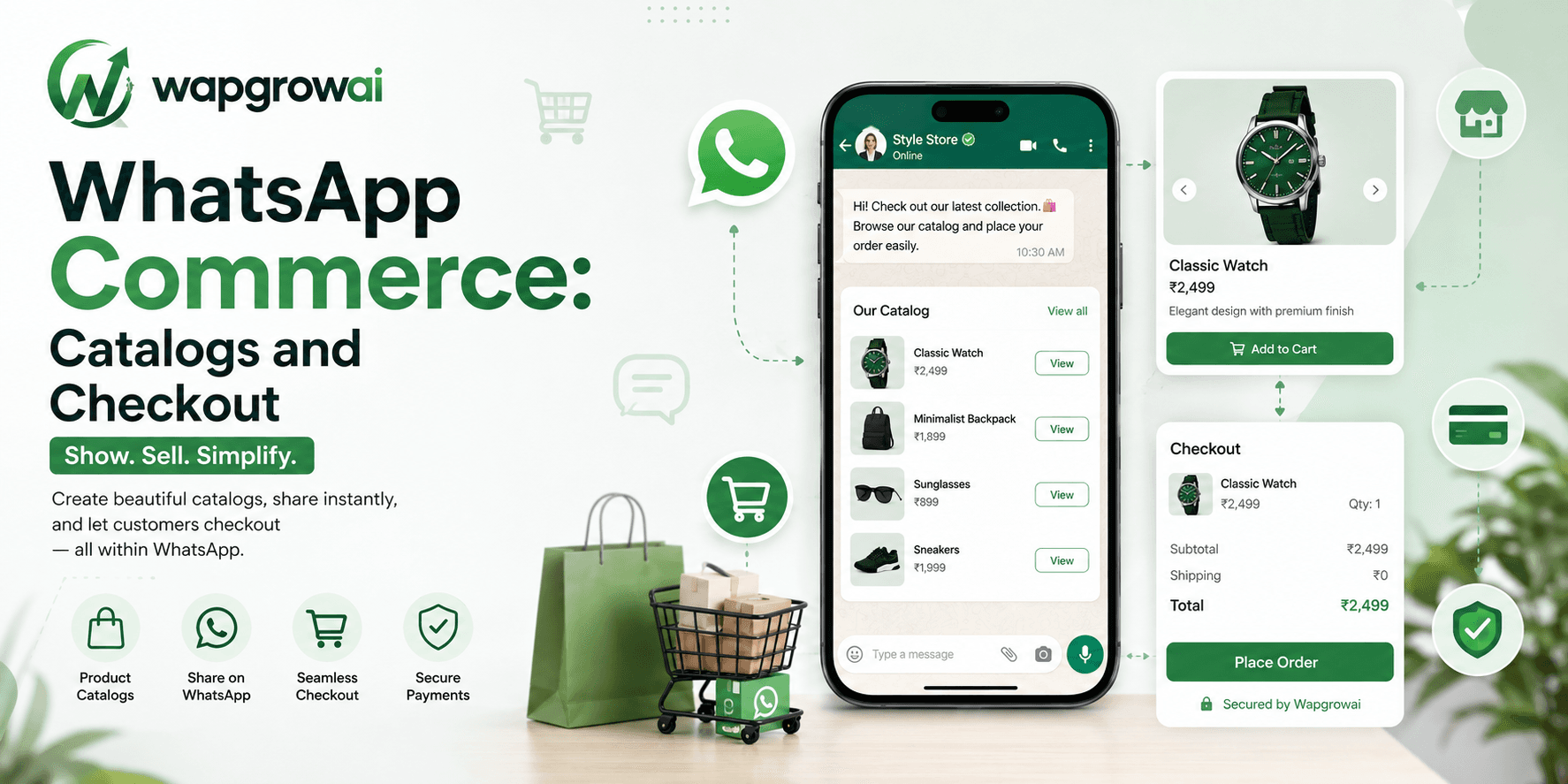
For most of e-commerce history, the chat was a support channel and the website was where money changed hands. WhatsApp commerce collapses that distinction: the customer browses, asks, decides, and pays without ever leaving the conversation.
Whether that is a good idea depends entirely on what you sell. For some catalogues it is transformative. For others it is a worse version of a website with fewer photographs. Knowing which one you are is the first decision, and it is the one businesses skip.
When chat commerce genuinely wins
Selling in chat outperforms a website in a specific and predictable set of situations.
- Considered purchases where the customer has a question that a product page cannot anticipate.
- Repeat purchases, where the customer knows what they want and a website is pure friction.
- Small catalogues, where browsing is not really browsing — it is choosing between six things.
- Markets where mobile data is expensive and a website is a slow, costly page load.
- Anything where trust is the barrier, and a real reply from a real business is what closes the sale.
And it loses, reliably, when the customer wants to compare forty items on a large screen. Do not try to rebuild a category page inside a chat thread. You will produce something worse than both.
The catalog, and the discipline it demands
A WhatsApp catalog is a browsable product list inside the conversation. It works, and its limitations are what make it work.
You cannot dump three thousand SKUs into a chat and call it merchandising. The catalog is a curation exercise: it should hold your bestsellers, your current promotion, and the things people actually ask for. Everything else belongs on the site, linked when relevant.
The conversation is the merchandising
On a website, merchandising is layout — what is above the fold, what is featured, what the filters do. In a chat, merchandising is dialogue. The bot or the agent asks a question and narrows the field, which is exactly what a good shop assistant does and exactly what a filter panel is a poor imitation of.
- Ask one qualifying question. What is it for, what size, what budget — one.
- Send two or three options, not twenty. Choice paralysis is worse in a chat than on a page, because scrolling back is painful.
- Recommend one of them, and say why. This is the entire advantage you have over a website, and most businesses do not use it.
- Make buying the next tap, not the next page.
A website can show a customer everything. A conversation can tell them what to buy. Only one of those is a competitive advantage, and it is not the one most brands try to replicate in chat.
Checkout, and the handoff that kills it
Everything is going well until payment. This is where most WhatsApp commerce flows lose the customer, and almost always for the same reason: the checkout throws them out of the conversation and onto a web page that does not know who they are.
The customer, who has just had a pleasant, fast, personal exchange, now finds themselves on a generic cart page being asked to enter an email address and create an account. The intent evaporates precisely at the moment you were about to capture it.
Fix the seam, in order of preference:
- Pay inside the thread, where your market supports it. Nothing beats not leaving.
- A payment link that opens a page with the cart already built, the address pre-filled, and no account required.
- If it has to be the website, carry every piece of context across — items, quantities, discount, and identity — so the page opens on the final step, not the first.
After the sale, which is where the margin is
The post-purchase thread is the part of WhatsApp commerce that businesses consistently undervalue. The customer has bought, they are in an open conversation with you, and the messaging window is free for a day.
- Confirm immediately, with the order details and a realistic delivery window.
- Update proactively at dispatch and delivery, before they think to ask.
- Handle the returns question in the thread — the alternative is a support ticket you pay for twice.
- Come back at the right interval with a reorder prompt, based on the product's actual life, not on a fortnightly cadence.
That last one is where repeat revenue lives. A coffee subscription reminder that arrives when the bag is nearly empty converts; the same message sent on a fixed schedule annoys. The difference is knowing what they bought and when — which, in a chat, you do.
The numbers to watch
- Chat-attributed revenue, kept separate from web revenue so you can see whether it is additive or cannibalising.
- Taps to purchase, from the first product view to payment confirmed.
- Drop-off at the checkout seam. If this is high, the handoff is the problem — not the product and not the price.
- Repeat rate among chat buyers versus web buyers. This is usually where the case for the whole channel is made.
The honest summary
WhatsApp commerce is not a replacement for your store. It is a better version of the shop assistant you cannot afford to put on every customer's shoulder — one that knows what they bought last time, answers in seconds, and can take the payment without sending them anywhere.
Build it for the customers who want to be told what to buy, keep the catalogue small, and obsess over the seam at checkout. Do those three things and chat becomes a genuine sales channel. Skip the third and it will remain, forever, a very engaging way to lose people at the last step.
Bot or human: who should be selling?
The question every store asks once the flow works, and the honest answer is: both, at different moments, and the handoff is where the money is made or lost.
A bot is excellent at the top of the conversation — greeting, qualifying, narrowing a catalogue of two hundred down to three. It is fast, it is available at midnight, and it never gets bored of the same question. What it cannot do is close a hesitant customer who has an objection they have not quite articulated.
A human is expensive, slow to scale, and dramatically better at exactly that moment. So the design writes itself: automate the funnel, escalate the decision.
- Bot handles discovery, availability, and price. All factual, all instant.
- Human takes over the moment there is hesitation, a comparison, or a question that starts 'but what if'.
- For high-value baskets, put a human in every time. The margin justifies it and the conversion difference is not subtle.
- For repeat purchases, keep the human out. A returning customer buying the same thing wants speed, not conversation.
Returns and complaints in the thread
Selling in chat means you also handle the aftermath in chat, and businesses that build a beautiful buying flow with no thought for what happens when it goes wrong get a rude surprise.
The customer who bought in the thread will come back to the same thread when the item does not fit. They will not go to your website and find the returns portal. They will scroll up to the conversation where they bought it and type 'this is too small'.
- Handle it in place. Sending them to a portal at this moment is the single fastest way to convert a return into a complaint.
- Have the order context on screen. They should not have to tell you what they bought — you sold it to them in this very conversation.
- Resolve or escalate within the thread, and never make them repeat themselves to a second person.
- Then ask if they want an alternative. A return handled well is a strong second sale, and a return handled badly is a review.
The thread is the receipt, the support ticket, and the relationship, all in one place. Treat it as disposable and you throw away the main advantage the channel gave you.
Starting small, and where to start
You do not need in-chat payments and a full catalogue integration to begin. The businesses that succeed at this start with one product and one flow, and expand only once the seam works.
- Pick your bestseller — the thing people already message you about.
- Build a single flow: a question, two options, a recommendation, a payment link.
- Route it from one entry point. A QR code on the packaging, or a link in your Instagram bio.
- Watch where people drop. It will be the checkout. It is always the checkout.
- Fix that, then add the second product.
That sequence takes a week and teaches you more about your customers than a quarter of analytics. And it means that when you do build the full catalogue experience, you are building it around a seam that already works — rather than discovering, three months in, that everything was fine until the moment somebody tried to pay.
Does chat commerce cannibalise the website?
This is the question a finance director asks in the second meeting, and the answer matters, because if chat revenue is simply web revenue wearing a different hat, the whole programme is an expensive lateral move.
The evidence, in the stores we have watched closely, is that it is mostly additive — but not entirely, and the honest answer depends on which customers you are reaching.
- New customers who would have bounced off the site are pure addition. They had a question, the site could not answer it, and they were gone.
- Repeat customers buying a known item are partly cannibalised — they would have bought anyway. But they buy sooner, more often, and with less friction, which shows up in frequency rather than in conversion.
- High-consideration purchases are strongly additive, because the conversation closes people the product page loses.
- Bargain hunters comparing forty items are neither. They will use the website, and they should.
The way to settle it internally is not an argument, it is a holdout. Run chat entry points on half your traffic and not the other half, and compare total revenue rather than channel revenue. If total goes up, the question is answered. If it does not, you have learned something important cheaply.
What this looks like in a year
A store that gets this right does not end up with a chat channel bolted onto a website. It ends up with a different relationship with a segment of its customers.
Those customers stop browsing. They message. They ask what is new, they ask whether the thing they bought last time is back, they ask which of two options you would recommend — and they buy, in the thread, in under two minutes, without ever opening your site.
That is not e-commerce with a chat widget. It is the corner shop, rebuilt at scale — where the person behind the counter remembers what you bought last time and tells you honestly whether the new one is any good.
Which is, if you think about it, what retail looked like before it was disrupted into a grid of thumbnails. The technology is new. The behaviour it enables is extremely old, and it turns out people still rather like it.
Three more,
worth your time
Ready togrow on WhatsApp?
Join 10,000+ businesses turning conversations into revenue.
Start free trialBook a demo