
How agencies manage 20+ WhatsApp accounts
Workspaces, permissions, and reporting that keep working past the point where spreadsheets and shared logins give up.
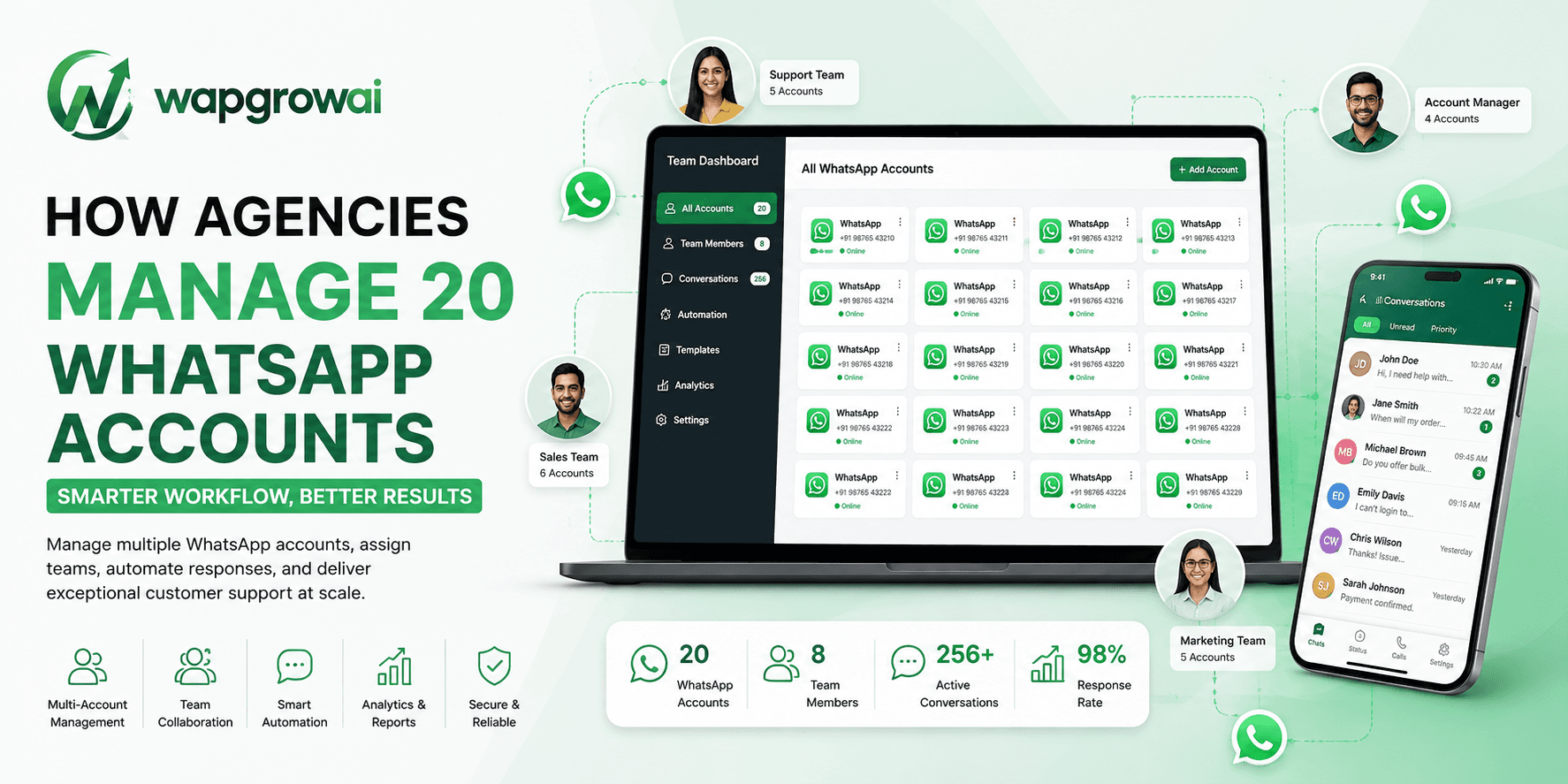
Running WhatsApp for one client is a marketing exercise. Running it for twenty is an operations problem, and the agencies that struggle are almost always the ones that scaled the first thing rather than switching to the second.
The symptoms are recognisable. A shared login that four people use. A spreadsheet that tracks which client is on which number. A reporting day that consumes a full working day, every month, forever. And the quiet fear that somebody, someday, will send the wrong campaign to the wrong client's list.
Separate the clients properly, at the account level
The foundational decision is isolation. Each client needs their own WhatsApp Business Account, their own number, their own templates, and their own contact list — with no path by which one can touch another.
Agencies resist this at first because it is more setup. They stop resisting it the first time a template approved for one client gets used for another and the tone is visibly wrong, or a broadcast list is uploaded to the wrong workspace. Isolation is not bureaucracy; it is the thing that makes the mistake impossible rather than merely unlikely.
Permissions, so that access matches responsibility
The shared login is the original sin of agency operations. It makes every action anonymous, which means nothing can be audited and nobody can be trained.
- Every person has their own account. Every one.
- Account managers get access to their clients only — not to the full roster.
- Sending a broadcast is a separate permission from drafting one. The person who can compose should not always be the person who can fire.
- Admin rights sit with two people, not with everybody who has been there a while.
This is not about distrust. It is about the fact that the worst mistakes in agency work are made by competent people moving quickly in the wrong workspace, and permissions are the only thing that reliably stops that.
Build once, deploy many
The leverage in agency work is not in running twenty campaigns. It is in running one campaign twenty times, with the parts that differ isolated from the parts that do not.
- Build a flow — cart recovery, lead qualification, appointment reminders — as a template, once.
- Parameterise the parts that change: brand name, tone, offer, timing windows.
- Deploy it into each client workspace, adjusting only those parameters.
- When you improve the flow, improve the template, and push the change out deliberately rather than rebuilding it by hand each time.
An agency with a library of ten well-tested flows can onboard a new client in a morning. An agency without one is quoting three weeks for work it has already done nineteen times.
Reporting that does not eat a day a month
Reporting is where agency margin quietly dies. Not because the reports are hard, but because they are assembled by hand, from four sources, once a month, by the most expensive people on the team.
If your monthly report takes a person a day to build, you are not running a WhatsApp practice. You are running a data-entry service that occasionally sends messages.
The fix is to decide, once, what the client actually needs to see, and then automate exactly that. In practice it is a short list: messages sent, delivered, and read; replies; conversions; revenue attributed; cost per conversation. Everything else is decoration that will generate questions you then have to answer.
The onboarding problem, and who should own it
Every new client arrives with the same obstacles: Meta business verification, a display name that needs approving, a number to provision, and templates to get through review. Multiply that by twenty and it becomes the bottleneck that defines how fast your agency can grow.
This is the strongest argument for working through a Business Solution Provider that handles verification and green tick applications on your behalf. Not because you cannot do it — because doing it twenty times a year, badly, is a poor use of an account director.
- Standardise the document pack you request from every client on day one.
- Start verification before the kickoff call, not after it.
- Have the display name conversation early — it is the most common cause of a delayed launch.
- Set expectations honestly about the green tick. Most new clients will not get one, and promising it is how you lose trust in month two.
The numbers that tell you if the practice is healthy
Agency metrics are not client metrics. The client cares about conversions. You need to care about the shape of the operation.
- Time to launch a new client, measured from signature to first live campaign.
- Hours per client per month, which should be falling as your flow library grows.
- Flows reused versus flows built from scratch. If this ratio is not improving, you are not compounding.
- Reporting hours, which should trend towards zero.
An agency where those four numbers are all moving in the right direction can take on the twenty-first client without hiring. One where they are flat is about to discover that its growth is capped by its own admin.
The shape of it, once it works
A well-run WhatsApp practice looks unremarkable from the inside. Each client sits in an isolated workspace with their own number. Account managers see only their accounts. Campaigns are assembled from a library rather than invented. Reports build themselves and arrive before the call rather than the night before.
It is not exciting, and that is the point. The excitement in agency work should come from the campaigns, not from wondering whether somebody just broadcast the wrong offer to the wrong list.
Pricing the service
Most agencies price WhatsApp badly, and they do it in one of two ways. Either they bundle it into a social retainer, where it silently consumes hours nobody costed, or they price it per campaign, which caps their revenue at exactly the point where the work becomes automated and cheap to deliver.
The models that hold up look different.
- A setup fee that reflects the real cost of onboarding: verification, number provisioning, template approval, and the first flows. This work is front-loaded and it is worth charging for honestly.
- A monthly retainer for management, sized by the number of active flows and the volume of conversations rather than by hours.
- Message costs passed through at cost, visibly. Marking up Meta's conversation rates is a small margin and a large trust risk.
- Performance upside where the client's economics allow it — a share of recovered cart revenue, for instance, which aligns you with the outcome rather than the activity.
What to do when a client leaves
Some will. The measure of a well-run practice is not that nobody churns; it is that churning is boring.
If you followed the isolation principle — client owns the Business Manager, the number, and the WABA, with your agency granted access — then offboarding is a permissions change and an export. An afternoon.
If you did not — if the number is registered to your agency, the templates live in your account, and the contact list is in your workspace — then the client is now negotiating for access to their own customer relationships, and the ending is going to be ugly regardless of how good the work was.
Own the flows you built. Never own the client's customers. Agencies that blur that line win a short-term retention argument and lose every referral that would have come afterwards.
Growing the practice past the founder
The last constraint is usually the person reading this. In most agencies, WhatsApp expertise sits in one head — the person who learned the platform, understands the template rules, and knows why a broadcast failed.
That person becomes the bottleneck, and the practice stops growing at roughly the number of clients they can personally think about.
- Write the playbook down. Not a wiki nobody reads — a checklist per flow, per client type, that a new hire can follow on day three.
- Make the flow library the training material. Somebody who deploys the cart-recovery flow four times has learned the platform by doing.
- Move the specialist from doing to reviewing. Their job becomes approving campaigns and fixing what breaks, not building.
- Hire for judgement about customers, not for platform knowledge. The platform takes a fortnight to learn. The instinct for what not to send takes years.
An agency that does this can add clients without adding proportional headcount, which is the only definition of scale that matters in a service business. One that does not will keep taking on clients until the person who understands WhatsApp goes on holiday — and then everybody finds out at once exactly how fragile the whole thing was.
Selling WhatsApp into a client who is not asking for it
Most agency growth in this channel does not come from clients requesting WhatsApp. It comes from an account director noticing that a client's email programme is decaying and proposing something better.
That conversation goes badly when it is pitched as a new channel with a new budget line, and well when it is pitched as a fix for a problem the client already has and is already paying for.
- Lead with their number, not yours. Their email open rate, their cart abandonment, their support backlog.
- Propose one flow, not a strategy. Cart recovery is the usual choice, because it pays for itself inside a quarter and the maths is uncontroversial.
- Be honest about the constraints — opt-in, template approval, and the fact that the audience starts at zero and has to be built.
- Show them the bill before they ask. Conversation pricing surprises people, and the surprise is much worse arriving on an invoice than in a proposal.
The pilot that wins the retainer
Do not propose a six-month engagement to a client who has never used the channel. Propose a pilot with a defined end and an honest success criterion.
- One flow — cart recovery, or lead qualification, whichever fits their business.
- Six weeks, with a number agreed in advance that constitutes success.
- A holdout group, so the result cannot be attributed to something else.
- A single report at the end, showing revenue against cost, with no interpretation required.
Pilots structured this way convert into retainers at a rate that no deck ever will, because the client is not being asked to believe you. They are being shown their own revenue, from their own customers, against a control group that proves the counterfactual.
And if the pilot fails — if the number does not clear the bar — say so plainly and tell them not to proceed. You will lose one retainer and gain a client who trusts you for the next decade. In a business built on referrals, that is not a sacrifice. It is the strategy.
Three more,
worth your time
Ready togrow on WhatsApp?
Join 10,000+ businesses turning conversations into revenue.
Start free trialBook a demo