
Reducing support response times with automation
What to deflect, what to route, and where a human still beats a bot every single time.
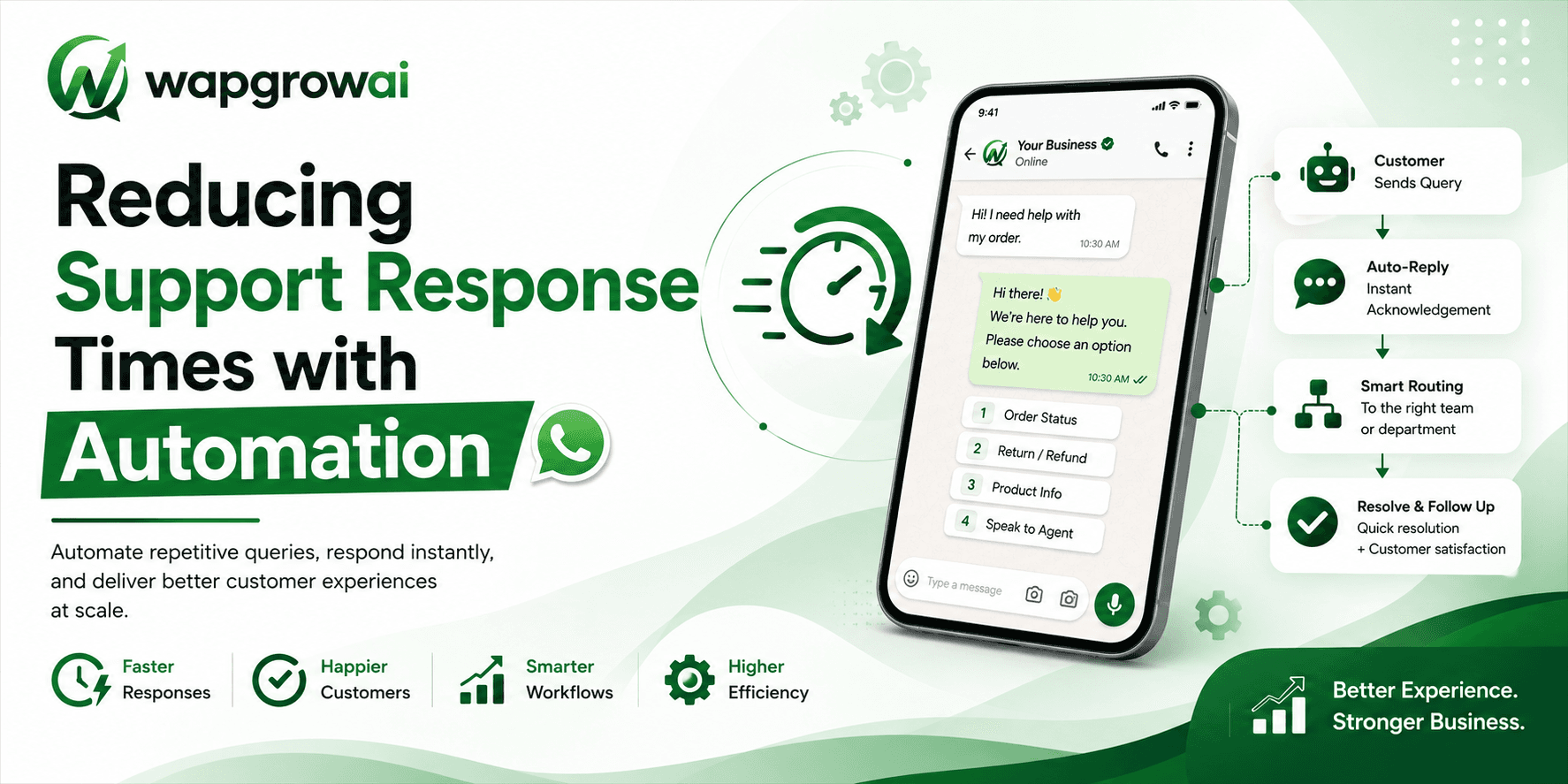
Support automation has a bad reputation, and it earned it honestly. A decade of phone trees and unhelpful chat widgets taught customers that 'automated' means 'you are about to waste four minutes before speaking to someone who could have helped you immediately'.
The version that works looks nothing like that. It is invisible when it succeeds, it gets out of the way instantly when it fails, and it is aimed squarely at the questions your team is tired of answering rather than at the ones that need judgement.
Start by counting, not guessing
Before automating anything, go through two weeks of conversations and count what people actually asked. Not what you think they ask — what they asked.
Almost every support inbox has the same shape. A small number of question types account for the majority of the volume, and they are usually dull: order status, opening hours, stock availability, how to return something, how to reschedule. Below that sits a long tail of things that genuinely require a person.
Automate the top of that distribution and nothing else. The long tail is where your team earns its keep, and it is exactly where bots do the most damage.
The three tiers
Sort every question type into one of three tiers, and treat each one differently.
Tier one: deflect completely
Factual, unambiguous, and answerable from data you already hold. Where is my order. What are your hours. Do you deliver to this postcode. These should never reach a human, and automating them well is pure gain — for the customer as much as for you, because the bot answers in two seconds and a human would take twenty minutes.
Tier two: gather and route
Questions that need a person, but where the person will start by asking the same three things every time. Here the bot's job is not to answer — it is to collect the order number, the photo, the account email, and hand a complete case to an agent who can then act immediately.
Tier three: straight to a human, fast
Complaints, cancellations, anything involving money going wrong, anything where the customer is upset. Automation's only role in this tier is to recognise it instantly and get out of the way. A bot that tries to handle an angry customer turns a recoverable situation into a public one.
First response time is the metric that moves everything
If you improve one number, improve this one. First response time correlates with satisfaction more strongly than resolution time does, which is counter-intuitive until you think about it from the customer's side: waiting without acknowledgement is the part that feels bad.
Automation gives you an unfair advantage here, because an instant, honest, useful acknowledgement costs nothing. Not 'we have received your message' — that is noise. Something that demonstrates the business is actually paying attention: confirming the order it is about, telling them where they are in the queue, and answering the question outright if it can.
Where teams get it wrong
- Optimising containment. The moment 'percentage handled without a human' becomes a target, someone will make the escape hatch harder to find, and satisfaction will fall while the dashboard turns green.
- Automating the exception rather than the rule, because the exception is more interesting to build.
- Letting the bot and the agents sound like different companies, so the handoff feels like being transferred to a different business.
- Never revisiting the flows, so that six months later the bot is confidently giving out last year's returns policy.
The first one is the most dangerous, because it is the one that looks like success. Containment is a diagnostic, not a goal. Watch abandonment alongside it: if more conversations are being contained and more customers are silently giving up mid-flow, the bot is not deflecting tickets. It is losing people.
The handoff is the whole experience
Everything the bot does well is undone by a bad handoff. If the customer has to repeat what they already told the automation, the automation has cost them time rather than saving it.
- Carry the full transcript into the agent's view. Every time.
- Carry the structured data too — the order number the bot looked up, the tag it applied, the branch it took.
- Tell the customer the handoff has happened, and be honest about the wait.
- Have the agent open with what they already know, not with a question the bot already asked.
'I can see your order 4021 is delayed and I have already chased the courier' is a sentence that only exists if the handoff was built properly. It is also the moment the customer decides your company is competent.
Measuring it honestly
- First response time, split by automated and human.
- Resolution time for conversations the bot touched versus those it did not.
- Abandonment mid-flow — your frustration signal, and the one that will not appear on a vendor's dashboard.
- CSAT, reported separately for bot-handled and human-handled conversations.
- Reopen rate. A conversation the bot 'resolved' that the customer reopens the next day was not resolved.
Reopen rate is the quiet one. A bot can post extremely flattering numbers by ending conversations rather than solving them, and reopen rate is the only place that shows up.
What good looks like
In a healthy setup, the bot handles the boring majority instantly, the agents spend their day on the problems that actually need a person, and the customer never has the experience of being trapped.
Your team should be able to tell you, without checking a dashboard, which questions the bot handles. If they cannot — if the automation is a black box that occasionally hands them something confusing — it is not saving them time. It is just moving the confusion around.
The AI question, answered plainly
Everything above applies whether your automation is a rule-based flow or a language model. But the choice between them is not a technology preference, and getting it wrong is expensive in a specific way.
Where rules win
Anything where being wrong is unacceptable. Order status. Payment confirmation. Anything involving a number, a date, or a policy. A rule-based flow either knows the answer or does not, and it cannot invent one — which is exactly the property you want when the answer is a refund amount.
Where a model wins
Understanding what somebody meant. Customers do not phrase things the way your keyword list expects, and a model handles the variety of human phrasing in a way that no amount of rule-writing ever will. The best configuration uses the model to work out intent, and rules to produce the answer.
Let the model decide what the customer is asking. Let your data decide what the answer is. The failures happen when you let the model do both.
The failure mode is worth being explicit about, because it is the one that gets written about in the press: a model that does not know the answer will produce a plausible one. It will invent a returns window, a delivery date, a policy. It will do this confidently, in your brand voice, to a customer who has no reason to doubt it. Rules cannot do that, which is a limitation everywhere except where it is the entire point.
Staffing around the automation
A successful bot changes the job of the people it works alongside, and teams that do not plan for this end up with an unhappy support desk and no idea why.
The bot takes the easy tickets. That sounds like a gift, until you consider what remains: a queue composed entirely of the difficult, the ambiguous, and the angry. The agent who used to punctuate their day with twenty quick, satisfying resolutions now has none of them.
- Expect handling time per conversation to rise after automation, and do not treat it as a regression. The mix changed; the work is harder now.
- Expect burnout risk to rise too. A day of nothing but complaints is a different job from the one they were hired to do.
- Rebalance the metrics. Judging agents on volume after a bot has taken the volume is a fast way to lose your best people.
- Give them the interesting work the bot cannot do — writing the flows, reviewing the failures, improving the answers. The people who know the questions best are the ones who should be teaching the bot.
The thirty-day check
A month after launch, sit down with three things: the abandonment-by-step chart, twenty full conversation transcripts chosen at random, and your agents.
- The chart tells you where people give up. Fix the worst step, and only the worst step.
- The transcripts tell you how it feels to be on the other side. Read them end to end; do not skim.
- The agents tell you what the bot is getting wrong that no metric is catching, because they are the ones apologising for it.
Do that every month and the automation gets steadily better. Skip it and it will slowly rot — still hitting its containment target, still reporting a healthy deflection rate, and quietly annoying a growing number of customers who have stopped bothering to tell you.
Out-of-hours: the easiest win nobody takes
If you are looking for the highest-return place to start automating, it is not your busiest hour. It is the hours when nobody is there at all.
At two in the morning, the bot is not competing with your best agent. It is competing with silence, and silence loses every time. A customer who gets a useful answer at midnight is a customer who does not spend the night deciding to buy from somebody else.
- Automate off-hours first. The bar is low, the risk is low, and the upside is a customer you would otherwise have lost.
- Be honest about the hour. 'Our team is offline until 9am — I can help with orders and delivery right now, or leave a message and they'll pick it up first thing.'
- Collect what the human will need. A conversation the bot could not resolve overnight should arrive at 9am as a complete case, not as a mystery.
- Measure the overnight conversion separately. It is usually the number that justifies the whole programme.
Language, and the trap of translating badly
If you serve customers in more than one language, automation is either your biggest advantage or your most public embarrassment, and the difference is whether the handoff speaks the language too.
A bot that answers fluently in Portuguese and then escalates to an agent who only reads English has not helped anybody. It has made a promise the business cannot keep, in the customer's own language, which is a particularly memorable way to fail.
- Detect the language from the first message, not from the country code.
- Route to an agent who speaks it, or be honest up front that the human reply will be in English.
- Use translation in the agent's view rather than pretending. Customers are remarkably tolerant of an agent using translation and remarkably intolerant of being stranded.
- Get the automated messages professionally translated. Machine-translated bot copy in a customer's native language reads as carelessness, because it is.
Done properly, this is where automation genuinely outclasses a human team: no support desk can staff eleven languages around the clock, and a well-built bot can hold the first line in all of them. Done carelessly, it is a fluent, confident, entirely useless conversation that ends in a language the customer does not read.
Three more,
worth your time
Ready togrow on WhatsApp?
Join 10,000+ businesses turning conversations into revenue.
Start free trialBook a demo